
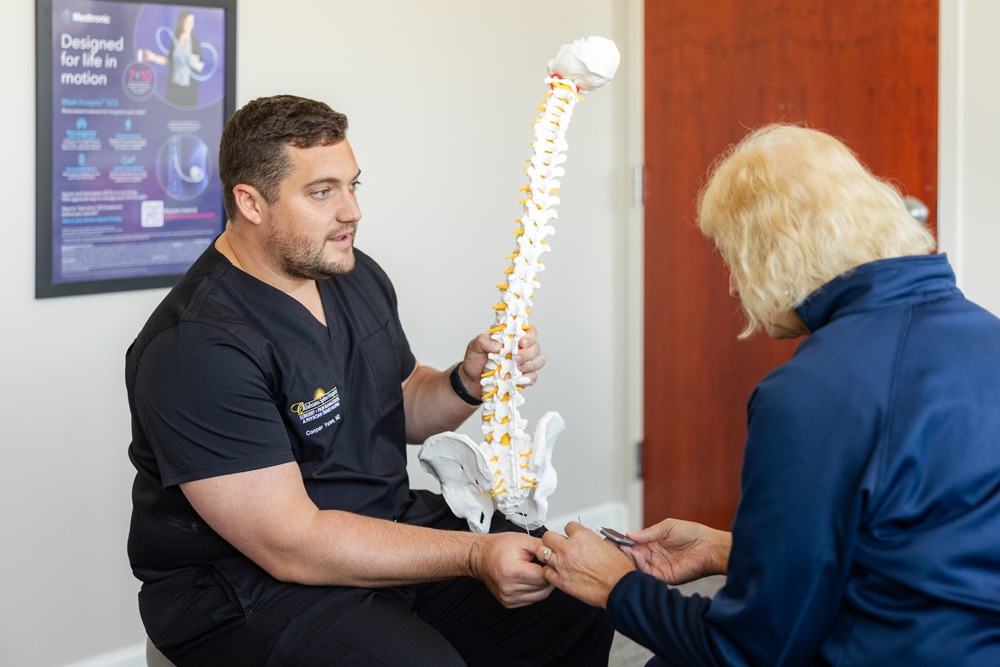
Medial Branch Anatomy
Facet joints are the joints connecting the different vertebrae of the spine to each other. Medial branch nerves are small nerves that supply the facet joints of the spine. These are sensory nerves that arise from the spinal column and transit into the facet joints throughout the spine.
What is a Medial Branch Block?
A medial branch block is an injection of a local anesthetic administered near the medial branch nerves to temporarily block the pain signal carried from the facet joints of the spine to the brain. It assists your doctor in diagnosing the cause of your back pain.
If a medial branch block is successful in confirming that the pain is originating from the facet joints, radiofrequency rhizotomy/ablation (RFA) is suggested to provide longer pain relief.
*Important to keep in mind that many insurances have different standards prior to RFA. Most require 2 positive (confirmatory) medial branch blocks prior to being able to complete the initial RFA at each attempted level.
Indications and Contraindications of Medial Branch Block
Medial branch block injections are usually indicated for back and neck pain that originates from arthritic changes in the facet joints or mechanical stress to the spine. A medial branch block can be performed to diagnose or treat pain arising from the facet joints. Facet joints are located in the cervical, thoracic, and lumbar spine, so medial branch blocks can be performed at each of these locations.
*some insurances do not cover thoracic medial branch blocks. Check with your physician for more information on this.
The procedure cannot be performed if you have an active infection or receiving antibiotic therapy. Also, inform your doctor if you are allergic to medications used in the procedure. Be sure to discuss these situations with your doctor before the procedure.
Preparing for a Medial Branch Block
You are advised to avoid driving after receiving this procedure, as there is a potential risk of numbing the motor/larger nerves in the back that can supply strength to the extremities. A driver will be needed to take you home regardless of receiving sedation or not for this reason. It is also required to not eat or drink for at least 4-6 hours prior to the procedure. You may take your approved medications with a sip of water.
Medial Branch Block Procedure
- A medial branch block procedure is performed under fluoroscopy (X-ray) guidance to ensure the accurate placement of the needle and to avoid nerve injuries.
- You will be made to lie on your stomach on an X-ray table. The area of the skin to be injected is cleaned properly and a local anesthetic administered to numb the skin. A stinging or burning sensation may be felt for a few seconds. A small needle is then directed into the medial branch nerve area, under X-ray (fluoroscopy) guidance. Contrast dye is used to confirm the location of the needle over the medial branch nerves. A small mixture of the numbing agent and steroid medication is then slowly injected over the targeted nerves.
- The whole procedure takes about 20-30 minutes and you can go home on the same day.
What to Expect after a Medial Branch Block
After the medial branch block, your pain may
- Be relieved for a few hours
- Be relieved for a few days
- Not reduce at all
If the pain is relieved after the medial branch block, it indicates that the origin of the pain is the medial branch nerve supplying the facet joint.
Based on the amount of pain relief observed during the first 6-12 hours after the injection, you may be considered suitable for a radiofrequency ablation (rhizotomy) procedure to relieve the pain for a longer period.
In radiofrequency ablation, an electrical current is passed through a needle at the selected medial branch nerve causing heat to interrupt the pain signals of those nerves. This is a procedure that hopefully can provide longer lasting relief to facet joint pain.
Post-procedural Care following a Medial Branch Block
- You should arrange for someone to drive you home after the procedure.
- You may continue your routine prescribed medications after a gap of 4-6 hours following the procedure to avoid incorrect assessment of diagnostic results related to pain relief.
- You may experience localized pain at the injection site in the first 2-3 days, for which ice packs can be applied to ease the discomfort.
- You can return to your regular activities, a day after the procedure.
* Important to know – your physician may ask you to go home after the procedure and do light activity (such as walking, bending, standing) to prove that you feel diagnostic pain relief the day of the procedure. This is to better assess if you truly have a positive medial branch block and relief of pain from the facet joints.
In cases where improvement in the pain is seen, you are advised to perform moderate activities, with regular exercises.
Risks and Complications a Medial Branch Block
Although a medial branch block injection is a safe procedure, the possible risks and complications associated with the procedure may include:
- Allergic reaction, usually with X-ray contrast dye
- Bleeding from the site of injection
- Infection at the site of injection
- Discomfort at the site of injection
- Temporary numbness to the motor nerves that supply the extremities. This, for example, can cause weakness in the leg(s) for multiple hours and will fade as the local anesthetic wears off. This is not dangerous and will improve usually by the evening or next morning.
- Increased pain
- Nerve or spinal cord damage and rarely, paralysis
